Jalyatra, Exploring India's Traditional Water Management Systems, is an ecological travelogue that looks at links between
water, society and places in an easy-to-read manner.
This book places water resources in the local environmental
and social context. It does so to make the case that water
management evolved in keeping with local conditions to
serve local populations.
Through eight locations in different parts of India, author Nitya Jacob brings out the stories around local water management systems. He describes in detail what existed, how it fitted into the socio-cultural milieu and was appropriate for the local climate and geography. He then examines reasons for their decline, as indeed most have, in recent decades.
In many places, NGOs and enlightened individuals are striving to revive these systems. Jalyatra captures their efforts. It makes the case for a mass movement to revive traditional water management systems, especially village ponds, across the country as THE way to ensure water security in India.
|
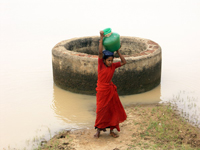
Girl pulls drinking water from Oorani, Tamil Nadu
Cormorants test in the Kabini lake
Deeg Palace's beautiful water ways
|
Dhara in Uttarakhand for drinking water
Evening aarti in Varanasi on the ghats
Gora talaab in Bundelkhand
|
|
Bamboo shyngiar in Meghalaya
Gate to regulate water flow in khazaan lands, Goa
Kund in Shekhawati, Rajasthan
|
|
|
Prologue
It's late when my jeep pulls into Godia village, a dusty habitation about a 100 KM from the town of Jhunjhunu in Shekhawati. There is no electricity and the streetlights are dark – the only illumination is from cooking fires. The day's drive through hot dusty roads has left me fazed, the driver frazzled and my companions extremely thirsty. I had a bottle of water, but they had none. We drive through the dark streets scattering dogs, chickens and pigs, and dodging cows. It seems we are hurtling through the village to some destination.
A low wall appears out of the darkness in front and the driver veers left. A massive black buffalo looms out of the darkness there, and he stands on the brakes – we all grab whatever is in front to avoid going through the windscreen. The buffalo moves, staring at the headlights truculently while chewing cud. The road opens into a wide space beyond the animal and as if on cue, the power comes on. A string of bulbs on a single wire come on lighting up the site of nocturnal construction. Hard manual labour is done from the evening late into the night because its hot in the day and people tend to their lands in the daytime.
Three metal poles sunk in the ground form a tripod over a deep pit that a group of people – men and women – are digging at a point in the village where rainwater accumulates. The streets channel rainwater to this place and it forms a puddle that takes days to disappear, breeding mosquitoes in the process. It's a recharge well. It will eventually be 200 feet deep, unlined at the bottom but brick-lined along the sides to prevent collapse and covered with a concrete slab. Around the top, two concentric concrete walls with holes will break the flow of water rushing into the well and stop large debris from getting into the well, and keep animals and children out. It costs Rs 200,000 to make; the villagers are putting in 30 percent and a local NGO, the rest.
This well is one manifestation of the profound link between man and water. Apart from the obvious – 80 percent of our bodies are made of water and without it we could not grow food or produce goods – water is the source of life. The quest for water is nothing short of a pilgrimage. Over the millennia Indians evolved seemingly disparate systems to manage water. These are as varied as the country's climate and geography. They don't seem to have anything in common, on the face of it at least. But scratch below the surface – like still waters, traditions run deep. Each variety of local technology has evolved organically, been fostered locally and perfected through trial and error. "Stupid ignorant peasants" we educated city slickers call them, but their wealth of knowledge holds the promise of India's water security.
|